Plenty of people do a jigsaw because it’s relaxing, and somewhere along the way someone tells them it’s “good for the brain”. It’s a nice thing to hear. But is it true?
We read the main studies so you don’t have to. Here’s what they found, what they didn’t, and how to get the most out of the puzzles you’re already enjoying.
What happens in your brain when you do a jigsaw?
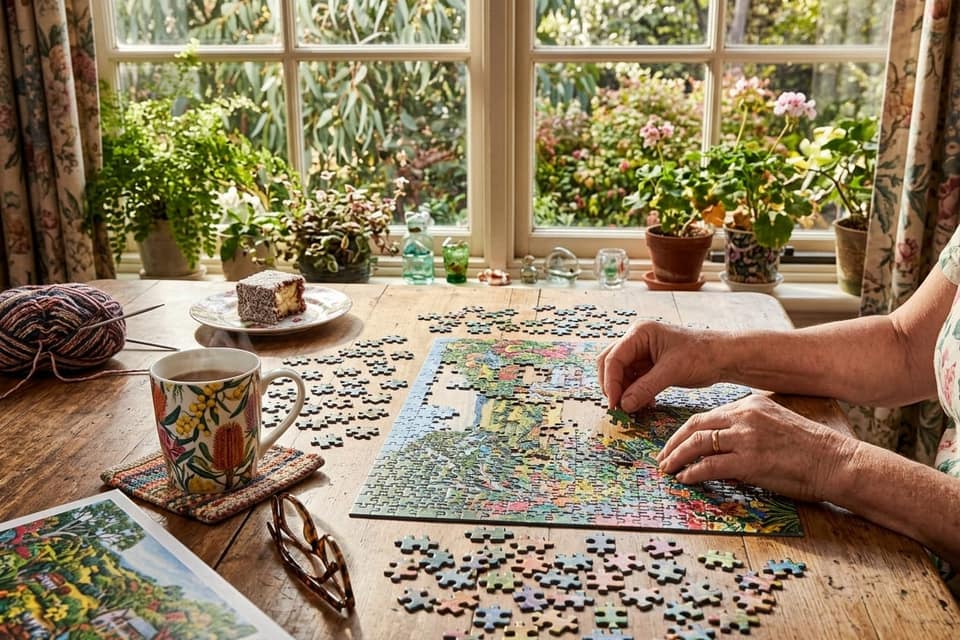
A jigsaw asks a lot of your thinking at once. You compare shapes and colours, turn pieces in your mind, remember where you saw a bit of sky, and keep a plan for the whole picture while you work on one corner.
A team at Ulm University in Germany set out to measure this. In their 2018 study of 100 adults aged 50 and over (opens in a new tab), they found that jigsaw skill was linked with eight separate thinking abilities: perception, putting shapes together, mental rotation, speed, flexibility, working memory, reasoning and memory for what you’ve seen. Their point was simple: a jigsaw isn’t one skill, it’s a workout for many.
Did puzzling actually improve people’s thinking?
This is where it gets more interesting, and more honest.
The same German study was also a proper trial. Half the group did jigsaw puzzles at home for 30 days within five weeks, for at least an hour a day. On average they put together more than 3,500 pieces. The other half didn’t puzzle. Both groups had four health counselling sessions.
After a month, the puzzlers had become better at jigsaws. But on the main test of visual thinking, they did no better than the group who hadn’t puzzled. Both groups improved a little, probably from doing the tests twice.
So a month of puzzling didn’t make a measurable difference.
So where does the “good for your brain” idea come from?
From the long term. Before the trial started, the researchers asked everyone how much they had puzzled over their lifetime. People with more years of puzzling behind them scored better on visual thinking, even after allowing for age, education and other activities.
The authors’ own summary is careful: they say long-term, but not short-term, jigsaw puzzling could benefit thinking. They also say the link isn’t necessarily cause and effect. People with good visual skills might simply enjoy puzzles more.
What about dementia?
The largest study on this comes from Australia. Researchers at Monash University followed 10,318 people aged 70 and over for about ten years (opens in a new tab) and asked about their hobbies and habits. Here’s what each kind of activity was linked with:
| Activity group | What it included | Link with dementia risk |
|---|---|---|
| “Adult literacy” | Classes, using a computer, writing letters or a journal | 11% lower risk |
| “Active mental” | Games, cards, chess, crosswords and puzzles | 9% lower risk |
| Creative | Craft, woodwork, painting, drawing | Smaller link |
| “Passive mental” | Reading, TV, music, radio | Smaller link, which faded in some checks |
| Social outings and networks | Seeing friends, going out | No link found |
Each figure is for doing that kind of activity more often (moving up one level of how often).
Two cautions matter here. First, this was an observational study: it watched what people did, it didn’t assign them puzzles. The authors say they can’t rule out that people who were already in the earliest, unnoticed stages of memory change simply did fewer puzzles. Second, most participants were healthy, white Australians who volunteered for a health study, so the results may not apply to everyone.
The surprising finding that socialising wasn’t linked with lower dementia risk doesn’t mean company doesn’t matter. It matters a great deal for wellbeing and mood. It just wasn’t tied to dementia risk in this group.
What the research doesn’t show
It’s worth saying plainly:
- No study shows jigsaw puzzles prevent dementia. The links are associations.
- A few weeks of puzzling isn’t enough to measure a change. Any benefit seems to come from years of the habit.
- Puzzles aren’t a substitute for the things with stronger evidence, such as staying physically active, looking after your blood pressure, hearing and eyesight, and not smoking. A GP is the right person to talk to about memory worries.
How to get the most out of puzzling
If puzzles may help over the long run, the best puzzle habit is one you’ll keep. These ideas are built on that:
- Pick pictures you love. You’ll come back to a picture that means something to you. Photos of places you know, or of your own family, are hard to put down.
- Mix up the challenge. Go up in pieces when it starts to feel easy, and down when you just want to relax. Stretching a little is part of the point.
- Make it a daily ritual. Ten or fifteen minutes with the morning cuppa counts. Little and often is easier to keep up than a marathon once a month.
- Try it on a screen as well as the table. Online puzzles let you make the pieces bigger, need no table space, and don’t lose pieces under the couch.
- Do it with someone. A puzzle is a gentle way to spend time with grandkids, a friend or a neighbour, and conversation happens on its own.
One way to do several of those at once is a puzzle made from your own family’s photos. With Family Pieces, the family sends photos from their phones and each morning one arrives as a jigsaw, hidden until the last piece goes in. You can try the free daily puzzle in your browser.
The bottom line
Jigsaw puzzles use many thinking skills at once, and people who keep the habit for years tend to have sharper visual thinking. A large Australian study linked puzzles, cards and crosswords with a modestly lower risk of dementia. None of this proves puzzles protect the brain, and a few weeks won’t change much on their own.
What the research does support is this: if you enjoy puzzles, keep doing them, make them a regular part of your week, and pair them with the other habits that look after your health.